
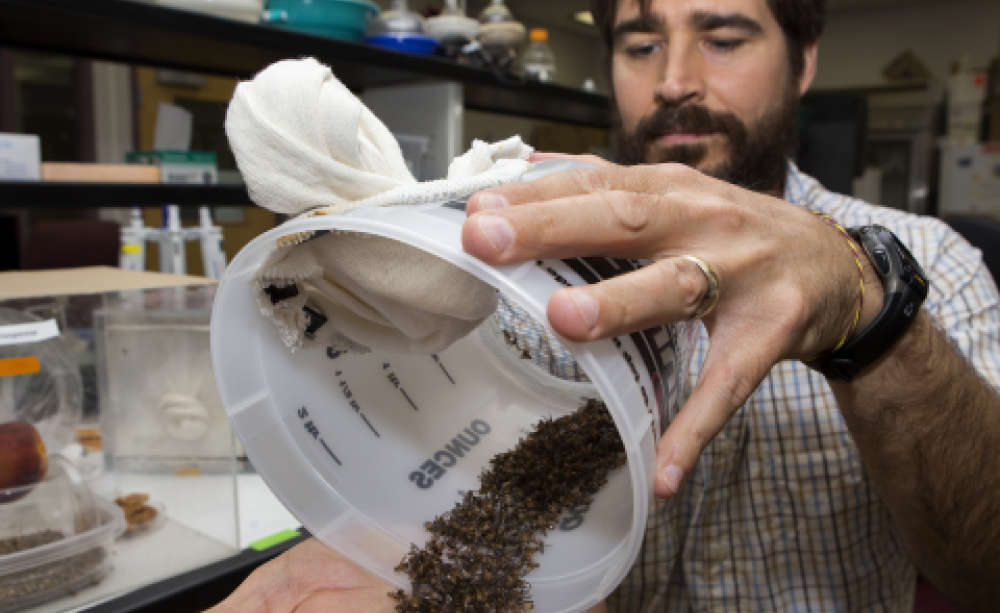
Our males are not only more sexually competitive, they are maintaining their sexual competitiveness and their virility, into old age.
The core technique is established - to blitz an outbreak of fruit flies with sterile males. A female accepting a sterile male has no offspring, thus trimming the population and its threat to crops.
The 'sterile insect technique' (SIT) has been used effectively against the Mediterranean fruit fly, called the Medfly, and the cattle-infesting screw-worm fly, among others.
The system is employed in agricultural areas in Florida and California - and it works, cutting insect damage and eradication costs by many millions of dollars a year - but still not as well as scientists would like.
This is because to sterilise the male flies, they have to be exposed to damaging radiation - like X-rays or gamma rays - and as well as making them infertile, it also makes them weaker, shorter-lived, and less attractive to females.
Low oxygen levels are curiously invigorating
But Daniel Hahn, an associate professor with the University of Florida's Institute of Food and Agricultural Sciences, and his former postdoctoral associate, Giancarlo López-Martínez, now an assistant professor at New Mexico State University, have a solution: to irradiate the flies under low oxygen conditions.
Putting the flies a low-oxygen environment before and during sterilization boosted the sterile males' longevity as well as their ability to attract and successfully mate.
They also found that the positive effects of low-oxygen treatments even extended into their 'old age' - in the insects' case, about 30 days under cushy laboratory conditions.
"Our males are not only more sexually competitive, they are maintaining their sexual competitiveness and their virility, into old age", Hahn said, "and that has the potential to make them much better biological control agents."
Cheaper and more effective
Treatments that both improve the sexual performance of sterile males and maintain high performance longer in older males can substantially increase the effectiveness and decrease the economic costs of SIT programs.
Florida spends roughly $6 million a year using SIT to prevent Mediterranean fruit fly infestations, while California spends about $17 million a year.
Moreover the new technique may offer the potential to extend the use of SIT into wider agricultural use, displacing conventional pesticide treatments.
The discovery is described in two scientific papers, one in the January edition of PLoS One, and one in the February edition of the Journal of Economic Entomology.


