Impunity reigns in the Amazon, write Joe Sandler Clarke & Sam Cowie, and the indigenous peoples of the forest are the big losers as they suffer repeated killings and land grabs. Big cuts to Funai, the agency meant to protect Brazil's indigenous tribes, have encouraged land barons to expand their land holdings into indigenous territories and murder any who resist.
On the one side, the Guarani people and the entire panoply of international and Brazilian law asserting the rights of indigenous peoples to their lives, lands, and way of life. Against them, the entrenched economic and political power of farmers, ranchers, loggers and others exploiting the wealth of the Guarani's soils, forests and waters. Right now the power of money is winning every time. Only with international pressure can the Guarani emerge victorious.
Attacks on Amazon Indians and on their land rights are threatening vital areas of rainforest, writes Jan Rocha. Meanwhile FUNAI, the agency responsible for safeguarding indigenous tribes is being forced to withdraw from key conflict zones due to underfunding, while Indians' attempts to assert their rights are met with state violence.
Brazil's extreme right wing government is preparing to open up the rainforest territories of dozens of uncontacted indigenous tribes to 'free for all' development by defunding the protection they currently receive, according to information received by Survival International, which warns: 'The reality is these cuts could sanction genocide.'
A unique and pristine coral reef in the mouth of the Amazon is threatened by oil drilling planned by oil giants Total and BP, say the scientists who recently explored it. But the oil companies are determined to press ahead despite the risks, writes Lawrence Carter, and Brazil's environment ministry is set to give its approval.
Land grabbing has been going on since the mists of time, writes Nikita Sud, and took off like never before under European colonialism. But now 'developing' countries are also getting in on the act - notably China, an economic superpower in its own right, as it ruthlessly, and often corruptly, expands its global land holdings at the expense of nature and small scale farmers.
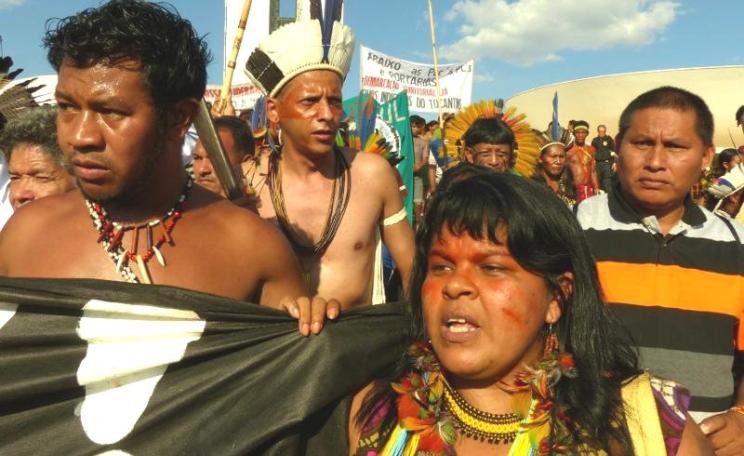
Brazil's indigenous peoples rose up against the government's plans to suppress the rights they had fought so hard to win over decades, writes Christian Poirier. Their victory shows the way to defend our achievements and rights: collective struggle, organized response, strong mobilization and ceaseless pressure.
Today, the Chief of the Paiter Surui indigenous people in the state of Rondônia, Brazil has issued the following plea for help to stop illegal logging and mining on their lands. The letter is unedited.
It's not that Dilma Rousseff, Brazil's ousted President, was wonderful for the environment, writes Ed Atkins. It's that Michel Temer's new regime is certain to be far worse. Plans are afoot to weaken environmental assessments for large projects like mines, roads and dams. And the new Minister of Agriculture is a notorious campaigner for hugely increased deforestation.
In the thick of the Olympic frenzy, one voice that was systematically excluded from mainstream narratives is that of Brazil's Indigenous Peoples, writes Lewis Evans, who have fought to survive through centuries of dehumanisation, theft and genocide. And now they face a fresh attack as a proposed constitutional change, PEC 215, threatens a new round of indigenous land theft.
Brazil's new neoliberal government is intent on building a massive new dam deep in the Amazon rainforest on the on the Tapajós river, writes Helle Abelvik-Lawson, obliterating the indigenous territory of the Munduruku people in defiance of their constitutional rights.
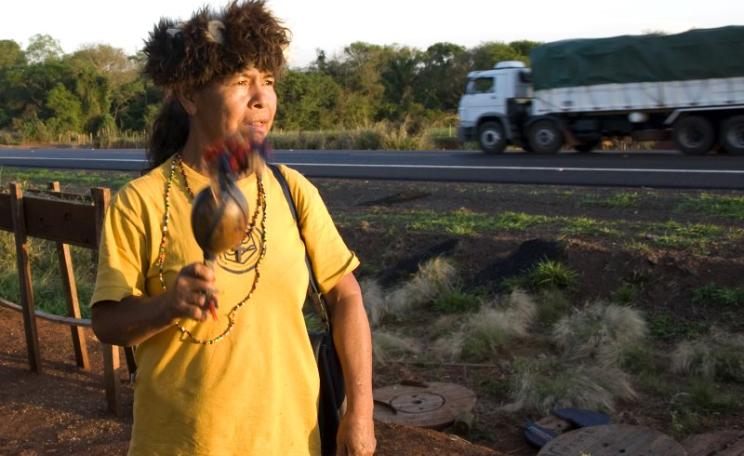
Land theft, agribusiness and violence pose an existential threat to Brazil's Guarani people, writes Lewis Evans. They maintain a powerful resolve to regain their historic lands, and even have the law on their side - but the tribe will need international support to prevail against murderous ranchers and farmers, corrupt politicians and a paralysed legal system.
A constitutional amendment that would allow 'strategic' public works including dams, roads, mines and other mega-projects to go ahead following the mere completion of an environmental impact assessment is being considered by a Committee of the Brazilian Senate, writes Helle Abelvik-Lawson.
Amidst the turmoil of the presidential impeachment, writes Jan Rocha, right wing members of Brazil's Congress are set to pass new laws that would build new roads across the Amazon, open up indigenous reserves to industrial exploitation, and create a surge in carbon emissions from burning forests.
Disregarding revelations of systemic political corruption in Brazil's hydropower sector, President Dilma Rousseff is ploughing ahead with a cascade of giant dams on the mighty Tapajos river. Among the companies touting to win huge construction contracts are France's EDF and Engie, and Germany's Voith and Siemens - in a consortium led by Brazil's Electrobras, which stands accused of high-level corruption over four other dam projects.
Those who dare suggest that pesticides might be implicated in Brazil's microcephaly outbreak are being furiously attacked as irrational, nonsense-spouting 'conspiracy theorists', writes Claire Robinson. But the attackers have an uncanny ability to get their own facts in a twist. And among them are writers linked to industries with huge economic interests in the matter.
With the proposed connection between the Zika virus and Brazil's outbreak of microcephaly in new born babies looking increasingly tenuous, Latin American doctors are proposing another possible cause: Pyriproxyfen, a pesticide used in Brazil since 2014 to arrest the development of mosquito larvae in drinking water tanks. Might the 'cure' in fact be the poison?
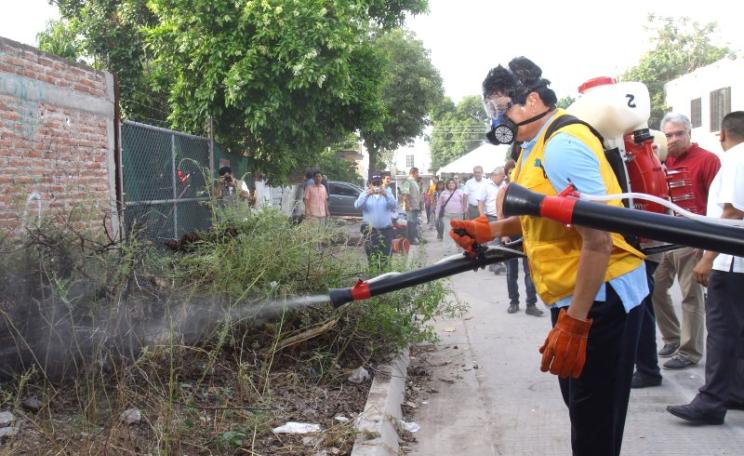
The Aedes mosquitos that carry the Zika virus and dengue fever are not just perfectly adapted to life in cities, writes Nadia Pontes. They are also being helped along by warming climates which increase their range. It's time to get serious about the health implications of a hotter planet.
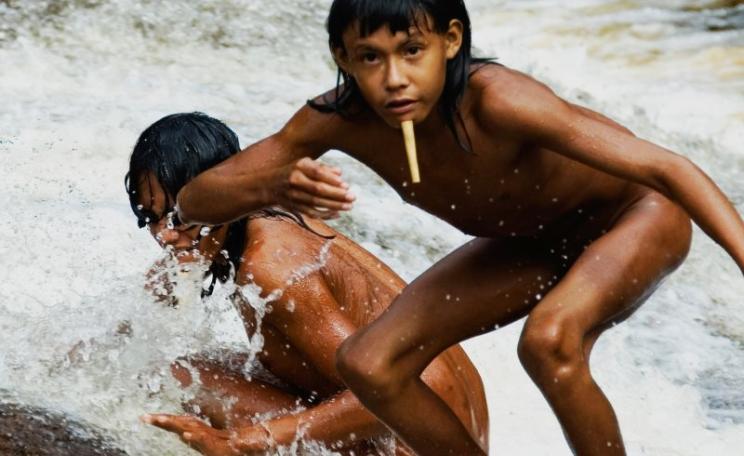
The Kawahiva, an uncontacted tribe in the Amazon rainforest, face extinction unless Brazil's government acts to secure their legal rights to land, security and to remain undisturbed by outsiders, writes Lewis Evans. The decree that would achieve this vital goal has been sitting on the Minister of Justice's desk since 2013. Let's make sure he signs it soon, before it's too late.
Roads, mines, dams, power lines, pipelines and other infrastructure projects are fast eating into the world's 'core forests', writes Bill Laurance. These rare and precious places where wildlife and ecological processes can flourish undisturbed must come before the evanescent gains of 'development'. To save what's left, governments and funders must learn the word 'No!'
In Brazil's microcephaly epidemic, one vital question remains unanswered: how did the Zika virus suddenly learn how to disrupt the development of human embryos? The answer may lie in a sequence of 'jumping DNA' used to engineer the virus's mosquito vector - and released into the wild four years ago in the precise area of Brazil where the microcephaly crisis is most acute.
Never mind Brazil's COP21 promises to cut its carbon emissions, writes Jan Rocha. New laws passing through Congress will encourage deforestation by removing safeguards and opening up indigenous territories to mega-projects. Serious drought is already contributing to a big increase in forest fires.
It's not just Indonesia's forests and peatlands that are burning - the Amazon is suffering almost as badly, with over 18,000 fires last month in Brazil alone, write Jos Barlow & Erika Berenguer. The future is looking hot and fiery.
Brazil has suffered its biggest ever industrial disaster, write Ana Luisa Naghettini & Geraldo Lopes. Breached and overflowing dams have released a massive slug of toxic muds and tailings from iron mining into the country's fifth largest river system that provides drinking water for downstream cities, destroying ecosystems in rivers and vast areas of biologically fragile ocean.