We are not able to fight everything, and even when we do fight, we are not able to win every time, writes Janey Stephenson. Some things are bigger than us. That is not our fault. Contrary to capitalist logic, that does not make us flawed or unproductive. Within our movements, it does not make us lazy or weak or failures. It makes us human. There is a time to rest.
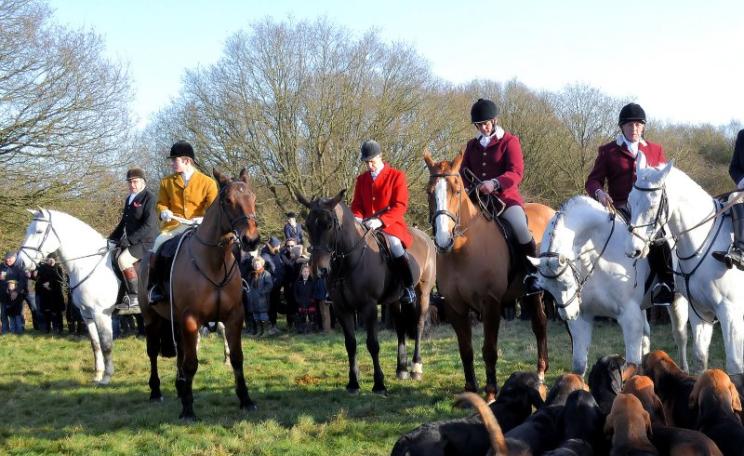
Teresa May's promise to bring back foxhunting has proved one of the most unpopular items in the Tories' election platform. So we should not be surprised at the official silence over the TB-infected hounds in the Kimblewick hunt, writes Lesley Docksey. Nor, given the political power of foxhunting landowners, should we be surprised that officials are shrugging off any idea that bad biosecurity in hunt kennels could possibly have anything to do with TB in cattle.
Has Monsanto, dubbed the 'world's most evil corporation', turned a new leaf? It has taken the 'probably carcinogenic' glyphosate out of a new version of its market leading 'Roundup' herbicide, and replaced it with vinegar. The bad news is it's only available in Austria. That, and it may still contain toxic 'adjuvants' to increase its effectiveness.
The real nature of war and its impacts on people and environment can only be understood through its ecology, surgeon Gus Abu-Sitta tells Andre Vltchek: the causes of conflict, the dynamics that sustain it, the corporate and strategic interests bent on its perpetuation, the deliberate destruction of health provision, and the repeating cycles of infection, injury, poverty and human misery which have become a permanent reality for uncounted millions.
A new study explains for the first time how nanoparticles like those in diesel exhaust fumes cause heart disease by lodging in inflamed blood vessels, writes Oliver Tickell. The study, published as the UK government is ordered before the High Court to justify its refusal to publish plans to tackle illegal air pollution which afflicts 38 million people, also raises wider fears about 'engineered nanoparticles' in the environment.
A new study in Pennsylvania, USA shows that fracking is strongly related to increased mortality in young babies. The effect is most pronounced in counties with many drinking water wells indicating that contamination by 'produced water' from fracking is a likely cause. Radioactive pollution with uranium, thorium and radium is a 'plausible explanation' for the excess deaths.
Five international judges say Monsanto's activities have negatively affected individuals, communities and biodiversity, writes Claire Robinson. The Monsanto Tribunal's damning ruling denounces the company's harmful impacts on food sovereignty, agricultural production, access to nutrition, the natural environment, seed diversity, climate change, pollution and traditional cultural practices.
The government / NFU badger culling policy is based on a single study, the Randomised Badger Culling Trials (RBCT), which found that area-wide badger killing reduced TB 'breakdowns' in cattle herds. But a robust reanalysis of the RBCT data reveals that culling is entirely ineffective, writes Tom Langton. The only scientifically valid conclusion is that culling badgers has no effect on TB in cattle. Defra and Natural England must think again!
'Smart meters' looked like a great idea, writes Lynne Wycherley, giving us more control over our energy use. The downside? They emit as many as 14,000 short bursts of intense microwave radiation a day, disrupting cellular electrochemistry and causing health symptoms from migraine to tinnitus, insomnia, dizziness, anxiety, chest pain, palpitations and memory loss. Now a growing number of 'electro-sensitives' have had enough!
A fresh wave of logging is hitting America's national forests, writes Brett Haverstick. But this time it's all for the sake of 'forest health' and 'fire prevention'. It might look like industrial clear-cutting to you and me, but really, it's in a good cause. And if the forests and precious ecosystems they harbor just happen to perish in the process ... well ain't that just too bad?
The Bovine TB conference in London last week was disrupted by media reporting of scientific conflict over badger culling studies, writes ecologist Tom Langton. But the real story is the collapse of confidence in the Randomised Badger Culling Trials, used to justify the mass killing of badgers; and the emergence of reliable new TB tests. The simple solution: stop the cull, and spend the money on gamma interferon cattle TB testing.
Pollution caused by burning fossil fuels are already causing the premature deaths of 200,000 people a year - in the US alone, writes Pete Dolack. Add up the figures worldwide and it comes to many millions. And that's before we even count the catastrophic long term impacts of global warming. The US response: to loosen anti-pollution regulation and encourage increased oil, coal and gas production.
MEPs vote today on proposals to cut air pollution by setting up an independent EU monitoring body to ensure that a scandal like Dieselgate never happens again, writes Keith Taylor. However fears are growing that Brexit promises the UK a bonfire of environmental laws including those on air pollution. We need a strong, new Clean Air Act now!
Below-par farm biosecurity should block farmers from participating in England's badger culls, writes Anna Dale. But a large body of evidence of poor and negligent biosecurity by farmers suggests that Natural England, the government's official regulator, is turning a blind eye to this strict requirement - and undermining the purpose of the cull.
A new study sets out the huge benefits of organic farming to people and the environment, writes Peter Melchett, including more wildlife, healthier consumers and farm workers, lower greenhouse gas emissions, reduced soil erosion and increased water retention. We need more of it, fast!
The badger cull is a clear failure on scientific, cost and humanity grounds, writes Dominic Dyer. Yet the government is planning a major extension of the cull in 2017. That's why he has just sent a copy of his acclaimed book to every British MP, before they debate the issue next week. Write to yours now demanding an end to the slaughter!
The discovery of a tiny but deadly radioactive 'hot particle' in mud from the Esk estuary near Sellafield has highlighted the dangers the nuclear site poses to residents and visitors, writes Chris Busby. Independent measures of radiation show far higher levels that those of regulators, similar to readings in the Chernobyl and Fukushima exclusion zones. Local villages should be evacuated.
Orthodox economic measures like Gross Domestic product fail to measure the things that matter most, write Judith Schleicher & Bhaskar Vira: like human wellbeing and ecological health. This creates a systematic bias in 'development' policies that must urgently be addressed if we are to build an inclusive, equitable and sustainable society
With the sixth anniversary of the Fukushima disaster falling tomorrow, nuclear lobbyists are arguing over solutions to the existential crisis facing nuclear power, writes Jim Green. Some favour a multinational consolidation of large conventional reactor designs, while others back technological innovation and 'small modular reactors'. But in truth, both approaches are doomed to failure.
The 2011 Fukushima catastrophe is an ongoing disaster whose end only gets more remote as time passes. The government is desperate to get evacuees back into their homes for the 2020 Tokyo Olympics, but the problems on the ground, and in the breached reactor vessels, are only getting more serious and costly, as unbelievable volumes of radiation contaminate land, air and ocean.
The sonic backdrop to our lives is increasingly one of unwanted technospheric noise, writes Paul Mobbs. And as it eclipses the sounds of nature, it's taking its toll on our health, wellbeing and quality of life. So as well as campaigning for more trees, and quieter cars, trucks and aircraft, what's to be done? Let us seek out calm moments of quiet tranquillity - and listen to the birds.
Was the discovery of bovine TB in a pack of foxhounds in southern England covered up? Jordi Casamitjana asks if hunts bear much of the blame for the bTB epidemic, while Defra may have deliberately suppressed the evidence. The 25 bTB-infected hounds of the Kimblewick Hunt may just be the tip of an iceberg of diseased dogs spreading TB across the UK - while badgers take the blame.
The news that the Kimblewick Hunt's hounds are infested with bovine TB has come as a shock to farmers and hunters, writes Lesley Docksey. But it's no surprise to campaigners against the badger cull, who have long complained about poor farm hygiene and the feeding by hunts of disease-ridden 'fallen cattle' carcasses to foxhounds - never mind that the cattle are likely bTB carriers!
Britain's long-suffering nuclear bomb test veterans have once again had justice denied to them, writes Chris Busby, by a shocking piece of judicial chicanery in London's High Court in which the judge whimsically excluded all the scientific evidence that did not suit the Ministry of Defence. But the veterans' fight for justice and scientific truth continues, facing its next test in the Court of Appeal.