President Obama and India's Prime Minister Modi are best of friends - aren't they? So how come the US took India to the WTO's trade court - and just won a resounding victory? And why isn't India challenging the US's own discriminatory solar subsidies? It's because of the money, writes Charles Pierson. And poor India has no choice but to play by Washington's rules.
Solar PV costs have fallen by 75% over five years ago, writes Chris Goodall, making it the cheapest new power source for around half of the world's population. Now it's essential to keep incentives to drive demand for a few more years, and make it cheaper than fossil fuels everywhere.
The Tories' decision to scrap the UK's renewable energy sector deserves condemnation, writes Oliver Tickell. But there is a silver lining: it creates the space in which to design better, cheaper, more cost effective support mechanisms to drive the clean energy revolution forward.
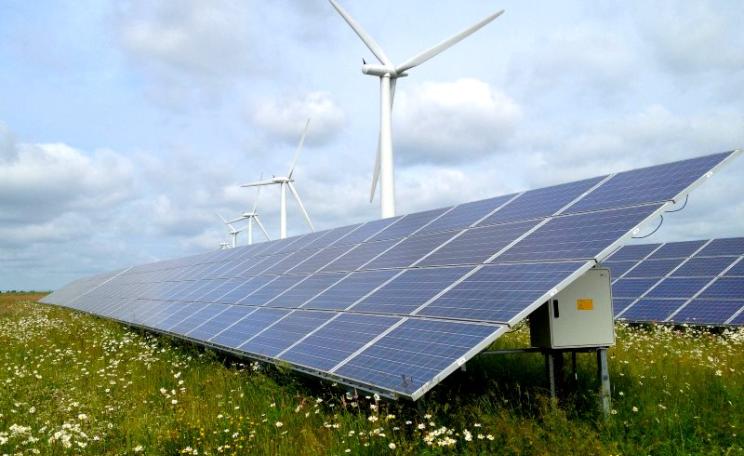
The UK government is to cut support for domestic rooftop solar to 13% of current levels, with similar cuts for bigger systems, and end all support for small scale renewables by 2019. The likely result, and surely the intention, is to kill off the UK's solar industry altogether.
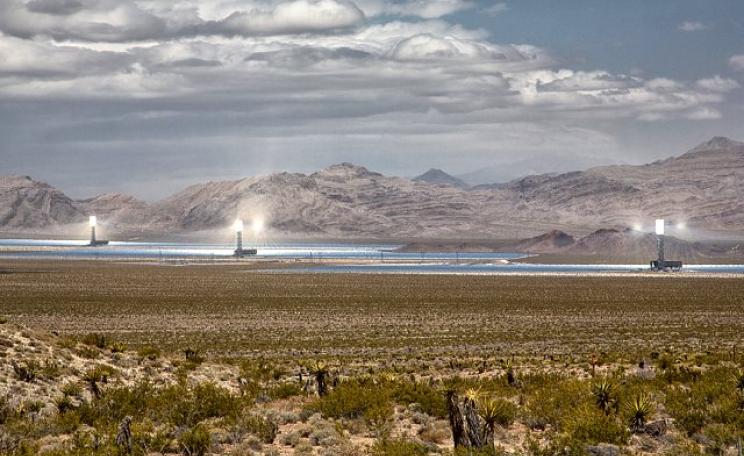
The 'other' solar technology, CSP, which uses mirrors to concentrate the sun's rays, is about to get a lot cheaper, writes Jeffrey Barbee. A South African team has developed a low cost design suitable for mass production that can be 'plonked' on site straight from the factory.
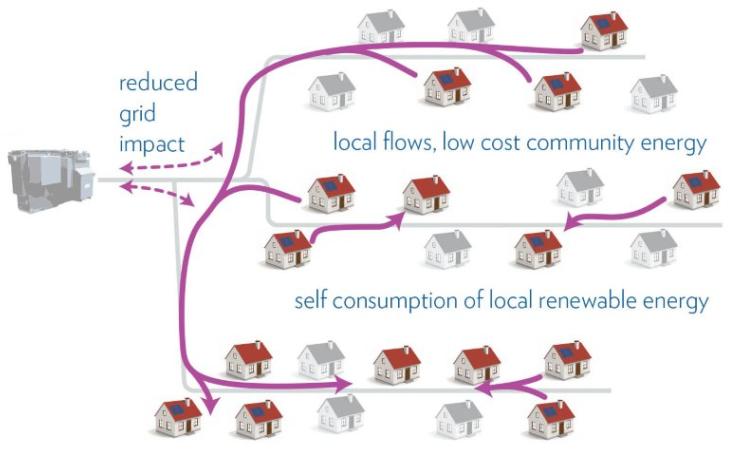
With centralised fossil-fuel and nuclear generation both undesirable and increasingly unviable, the answer is to make our energy local, distributed and renewable, writes Chris Wright. But to complete the picture we need battery systems for backup, stability and efficiency. And one could be coming your way soon ...
China is by far the world's biggest producer of solar panels, writes Kieran Cooke. But the industry is suffering from over-capacity, razor thin profits and a failure to innovate.
The success of the SNP and surveys carried out by DECC show that green energy is overwhelmingly popular, writes Keith Barnham. Labour's failure to support renewables and oppose nuclear power and fracking may have cost them the last election - but now, with the rise of Jeremy Corbyn there's a real chance for the party to put that right.
We need a renewable energy revolution, an end to fracking, no new nuclear power, efficient homes, and the break up of our energy cartels, writes Jeremy Corbyn, All that, and strong protection for wildlife and oceans, no TTIP trade deal with the US, clean air to breathe, and massive investment in public transport. Is there anything not to like?
Solar panels made using perovskite technology pay back the energy used to make them ten times faster than those using silicon. In time, this could lead to similar falls in price.
Never mind government inaction (or worse) on climate change, writes Assaad W Razzouk. Solar power costs just keep on falling, and it's already providing the lowest cost electricity across much of the world. With $7 trillion of investment piling into the sector, the momentum is now unstoppable.
Perplexed by today's sharp cuts in solar power and other attacks on renewable energy in the UK? Don't be, writes Oliver Tickell. Really, it all makes perfect sense. You just have to understand their real purpose: to keep your energy bills high, along with power company profits. And never mind the 'green crap'!
The UK government has announced massive cuts in support for solar roofs and farms that appear designed to undermine investor confidence just as the technology is on track to be subsidy-free by 2020.
As Greece prepares for its referendum, Takis Grigoriou takes Greece to task for its highly polluting lignite power sector, its ditching of a successful solar program in favour of more coal, the minimal insulation in its buildings that locks in high fuel bills, and Syriza's failure to tackle these issues. The good news? Greece's latest €1.4bn coal project looks like going unfunded.
Sunday's SpaceX crash sends a powerful warning of the dangers of nuclear power on spacecraft, writes Karl Grossman. But will NASA listen? Despite the success of solar-powered missions, it's planning to use plutonium to power future missions and a new report asserts a continuing need for the technology - even as Russia ditches the idea.
Thanks to the windy, sunny weather conditions on Saturday, the UK's output of renewable power reached an all-time record level of 43%, writes Chris Goodall. At the same time power from coal reached a low of just 7%, it what may be a record low contribution.
Solar energy is not just about electricity, writes Anne Wheldon. It's also about heat - and three innovative projects highlighted by the Ashden Awards are showing how solar heat can dramatically reduce the carbon footprint of food processing and farming, while helping agricultural businesses increase profits
A host of Pacific nations are turning to renewable technologies to satisfy 100% of their energy, writes Maxine Newlands. Samoa is aiming to achieve 100% renewable energy by 2017, while Tokelau has already reached 94% including 100% of its electricity.
Fed up with being gouged by profit-driven corporations, let down by state neglect and under-investment, urban communities across the US are taking control of local services like public transport, energy, water, internet and telecoms, writes Max Holleran - bringing better service, lower prices and clean energy.
Tesla Energy's new mains power battery has just transformed the energy market - giving a huge boost to small scale renewable energy and killing off both fossil fuelled and nuclear power in the process.
Hopes of strengthening Britain’s energy security are often pinned on the fossil fuel industry says Vicente López-Ibor Mayor, as exemplified by the hysteria over the claimed 'discovery' of 100 billion barrels of oil beneath Gatwick airport. But the real long-term solution lies with abundant and ever cheaper decentralised renewables.
The world's smart money is piling into renewable energy, solar power in particular, write Tim Radford & Oliver Tickell, as renewables pull away from fossil fuels in terms of both investment and new generation capacity added each year.
Without water to feed its hydroelectric dams, drought-hit Brazil is turning to solar power - dubbed 'a fantasy' by the country's president just a few years ago, writes Jan Rocha. Now thousands of megawatts of floating solar panel 'islands' are to be installed on dam reservoirs.
The UK will soon complete a record year for solar installations, almost doubling the nation's solar capacity. But drastic and overtly discriminatory changes to support for renewables may see solar installations collapse to 1% of current levels.