Taking place in the run up to Bristol's year as Green Capital 2015, this groundbreaking spiritual ecology conference calls for Consciousness Revolution.
A voter initiative in Maui, Hawaii requires a suspension of GMO crops pending a safety review to be paid for by Monsanto and other corporations - although corporations spent almost $8 million trying to defeat the measure. Monsanto is now preparing a legal challenge.
Legislation put forward by Brazil's re-elected President Dilma Rousseff would open up to 10% of protected areas to mining, writes Luke Parry. The effect would be to gut nature conservation in Brazil, already in a perilous state due to underfunding and growing pressure for the development of mines, dams, farms and plantations.
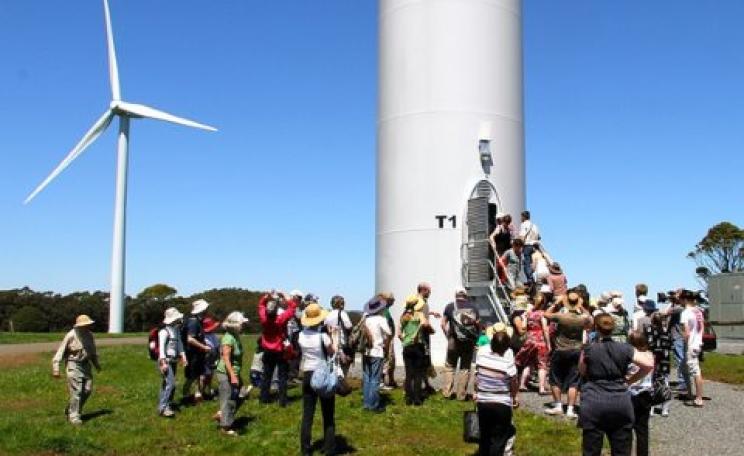
This is an exciting time for community energy, writes Julia Groves. New guidance will make it easier for local people to invest in local renewable power projects, while other opportunities are opening up for risk averse investors. And the more of us join in, the sooner we can displace the Big Six who dominate UK energy markets.
A orchard garden has taken root on a long-vacant lot in an economically and racially divided neighborhood of Boston, writes Orion Kriegman. In the making it has united a community, helped to heal deep scars of violence, and inspired a wider reclamation of the urban commons.
The Government's 'National Pollinator Strategy' has a fatal flaw, writes Georgina Downs - it contains no meaningful measures to address farmers' spraying of highly toxic pesticides, often in mixtures that can further increase the harm they cause. And with 80% of the UK's pesticides used in agriculture, that's setting the 'strategy' up to fail.
A new report reveals that Chinese-led criminal gangs are conspiring with corrupt Tanzanian officials and senior politicians to traffic huge amounts of ivory. The corruption even extends into the Chinese navy, diplomatic missions and Presidential entourage - all involved in the lucrative but illegal trade.
The revolution taking place in Burkina Faso is far more than an uprising of rebellious youth, writes Alexander Reid Ross. It's a genuine fight for national liberation - from neoliberalism, land grabs, corruption and foreign domination - that evokes the freedom struggle of an earlier generation.
Until demand for fish is balanced with sustainable methods of production, write Ruth Thurstan & Callum Roberts, governments should consider the social and environmental implications of promoting greater fish consumption. Worldwide, wild fish supplies per person have been declining ever since 1970.
The Gates Foundation is spending half a billion dollars a year to 'feed the world', most of it aimed at Africa. But as GRAIN discovers, it is imposing a model of high-tech, high-input 'green revolution' farming, complete with GMOs, agro-chemicals and a pro-business neoliberal agenda, all in in alliance with corporate agriculture.
With rising population and food demand far outstripping supply, the Sahel is vulnerable to a new humanitarian crisis, writes Alex Kirby. Rainfall is expected to increase with climate change, but higher temperatures will overwhelm the benefits.
The West African iboga root is a mind-transforming psychedelic, writes Michael Goldin, capable of cleansing people of even the most serious addictions. Those seeing this film will surely emerge convinced that iboga should be made available, in therapeutic settings, to those seeking to overcome the terrible disease that is drug addiction.
Seagrass provides a key marine habitat, writes Richard Unsworth - it stablises the sea floor, sustains rich ecosystems, soaks up excess nutrients, sequesters carbon dioxide, feeds dugongs, and nurtures young cod. Hadn't we better stop wiping out some 1,500 sq.km of seagrass meadows every year?
The cost estimates for solar PV used by the IPCC in its latest report fail to take into account recent price falls for the technology, reports Helle Abelvik-Lawson, and exaggerate financing costs. The result is to understate the importance of PV in a low carbon future.
Papers reluctantly released by the UK Government in the bomb test veterans' legal case for compensation reveal what it has long denied, writes Chris Busby - that bomb fallout is rich in uranium, and that most of its radioactivity is concentrated in the 'forgotten' but highly active isotope U-234, explaining much of the substantial, long term damage to veterans' health.