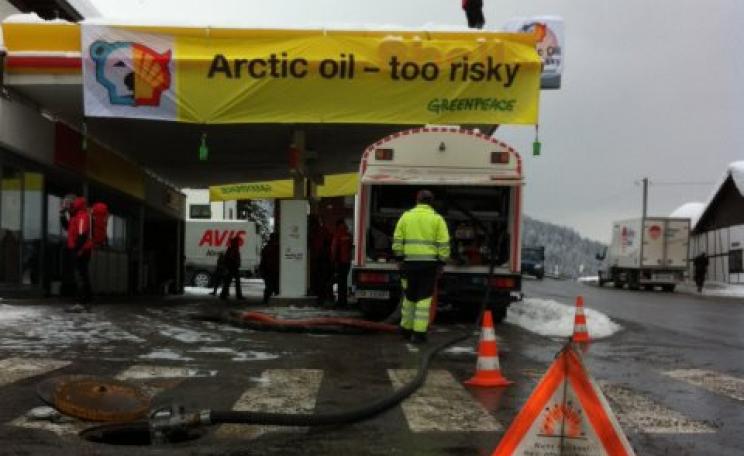
Following a 1 million signature Greenpeace petition, LEGO has pledged not to renew a 50-year link with the oil company Shell. The move comes as Shell bids to renew its Arctic drilling in 2015, and following revelations that it is trying to dilute environmental regulation in Arctic waters.
The UK's political mainstream has performed a complete U-Turn in policy on nuclear power, culminating yesterday in the European Commission's approval of a £15-20 billion subsidy package for the Hinckley C project. Donnachadh McCarthy delves into the nuclear industry's deep and far-reaching political links.
The outgoing European Commission has just given the UK's controversial Hinkley C nuclear project the go-ahead, writes Paul Dorfman - approving a deal that will cost the UK public tens of billions of pounds. But now the deal faces a legal challenge in the European Court of Justice.
The EU is dumping a plan to label fuel made from tar sands as 20% more polluting than oil from conventional sources, making it cheaper for European countries to import. But the concession - intended to smooth the TTIP trade deal - still has to be approved by the European Parliament.
There's a simple thing we can do to cut everybody's electricity bills, reduce pollution and 'keep the lights on' when demand peaks on dark winter evenings, writes Chris Goodall - phase out power-guzzling halogen bulbs and replace them with LEDs that use a fraction of the power. So let's do it!
Oil majors are gearing up to exploit Arctic oil, writes Mike G. But they don't want to carry the costs of all the safety equipment the US Government is demanding to protect the fragile Arctic environment from spills. And they're reluctant to give up the use of toxic chemical dispersants.
King Coal's reign is coming to an end, writes Chris Rose, at least as a fuel for generating electricity. Following a price collapse half of all production is being sold at a loss - and major coal users like China are still moving away from the high-carbon fuel.
There's an Alice in Wonderland flavour to the nuclear power debate, writes Jim Green. Lobbyists are promoting all sorts of new reactor types - an implicit admission that existing reactors aren't up to the job. But the designs they are promoting have two severe problems. They don't exist. And they have no customers.
When Shell decided to quit its Arctic oil exploration it cited 'insufficient quantities' of oil and gas, writes Louise Rouse. But that was not the whole story: what tipped the balance was a combination of investor discontent, reputational damage and public opposition on an unprecedented scale.
The movement to divest from fossil fuels is gaining strength, writes Ruth Lumley, with $50 billion of institutional investment behind it. This week's news that almost $1 billion of Rockefeller money is moving from fossil fuels to clean energy shows that the world is changing faster than most ever imagined.
Why so few Russian representatives at the UN's World Conference on Indigenous Peoples? Officials prevented activists - some opposing Arctic oil development - from leaving the country, damaging passports and detaining them so they missed their planes.
Japan's government is trying to get its failing nuclear power industry up and running, write Jim Green and Peer de Rijk. But in the post-Fukushima world, it faces formidable obstacles. Experts believe most reactors will never restart - and Japan's stricken utilities may have to find $30 billion or more to finance their decommissioning.
To tackle its serious air pollution, China is imposing stringent restrictions on dirty coal high in ash or sulphur, writes Shabbir Ahmad. One result: half of Australia's coal exports to China face exclusion, or extra 'washing' costs. But Australia's response is not to raise environmental quality. Instead, it's increasing production.
A health study in Pennsylvania, USA, shows that people living near fracking and other natural gas wells are more likely to suffer from skin conditions and upper respiratory symptoms. It calls for further study of the associations, including the role of specific air and water exposures.
Energy efficiency in office buildings struggles to gain the attention of top management, writes John Alker - because energy is too cheap to really matter. But with 90% of operating costs spent on staff, show that green building design makes employees happier and more productive, and you're really onto something ...